
BOARDING Boarding school life: what international students can expect at Earlscliffe

Starting at a UK boarding school is one of the most exciting and most daunting steps a young person can take. This guide gives students and families a clear, honest picture of what daily life at Earlscliffe looks like, from the moment they arrive to the day they leave for university.

Life at a UK boarding school

For many international students, joining a UK boarding school is their first extended time away from home, their first experience of the British school system, and their first real immersion in a language and culture that may be very different from their own. This guide is designed to help both students preparing to arrive and parents supporting them from abroad. It covers every aspect of daily life at Earlscliffe: the structure, the rules, the routines, the food, the friendships, and the things that take a little getting used to.

Earlscliffe is a small, specialist international boarding school in Folkestone, Kent. With students from more than 30 countries, it is a genuinely global community — and the school’s size means that every student is known personally, not lost in a crowd.

1. Arrival day and the first few weeks

Arrival day is one of the most carefully planned days of the Earlscliffe calendar. The school understands that first impressions matter and that a nervous student who feels welcomed and informed from the very first hour will settle far more quickly.

  • Before you arrive – You will receive a detailed arrival pack from Earlscliffe’s admissions team ahead of your start date. This will include confirmed term dates, travel guidance, a packing checklist, information about what to bring and what the school provides, and contact details for your house manager. Airport and train station transfer arrangements can also be coordinated through the school.
  • Welcome and registration – On arrival, students and families are welcomed by house managers and admissions staff. Students are shown to their boarding house, allocated their room and given time to settle in and unpack. Parents are invited to meet key staff, see the facilities and ask any remaining questions before departing.
  • Induction and campus tour – New students take a guided tour of the campus, meet the wider house community and are introduced to school systems, routines and key contacts. Dinner on the first evening is a communal affair, an early opportunity for new students to begin forming friendships across nationalities and year groups.
  • Academic induction and placement – The first week includes academic induction, timetable distribution and, where needed, assessment to ensure students are placed in the right subject groups. PSHE sessions cover school rules, expectations, wellbeing resources and how to get support. Students attend their first lessons and begin building relationships with teachers.
  • Settling in  – It is completely normal to feel homesick in the first few weeks. Most students experience it at some level, and the house managers at Earlscliffe are experienced in recognising and supporting it. Staying busy, joining house activities, and reaching out to other students (who have usually been through exactly the same thing) are all part of how the community helps each other settle. By the end of the first half-term, the overwhelming majority of students feel genuinely at home. The small community at Earlscliffe accelerates this process considerably.

Tip for students: Bring something from home that makes your room feel personal — a photo, a familiar item, a comfort object. It sounds small, but it matters enormously in the first weeks.

2. Support & wellbeing - Pastoral care at Earlscliffe

Pastoral care at Earlscliffe begins with the house managers, who live alongside students and who are responsible for their day-to-day welfare, safety and happiness. Each boarding house has a dedicated house manager (or pair of managers) who get to know every student in their house individually.

House managers monitor how students are feeling, notice when something seems wrong, and make themselves available for students who need to talk,  whether about homesickness, academic pressure, relationships or anything else. They are also the first port of call for parents who want to check in on their child.

In addition to house managers, Earlscliffe has a wider pastoral support structure that includes access to professional counselling, a PSHE programme covering mental health, relationships and life skills.

“Everyone shows interest in everything you are doing. Teachers, students and staff will always push you to be involved. Everyone works so hard to make you feel that you belong here.”
Elizaveta, Russia — University of Toronto

3. Where students live - Boarding accommodation

Earlscliffe operates a residential house system. Students live in small boarding houses situated across the school campus, each managed by a dedicated house manager team.

  • Bedrooms – Students are accommodated in twin-ensuite rooms, with the option to pay an additional fee for a single room. All rooms are furnished and include a bed, desk, storage and Wi-Fi access. Students are encouraged to personalise their space.
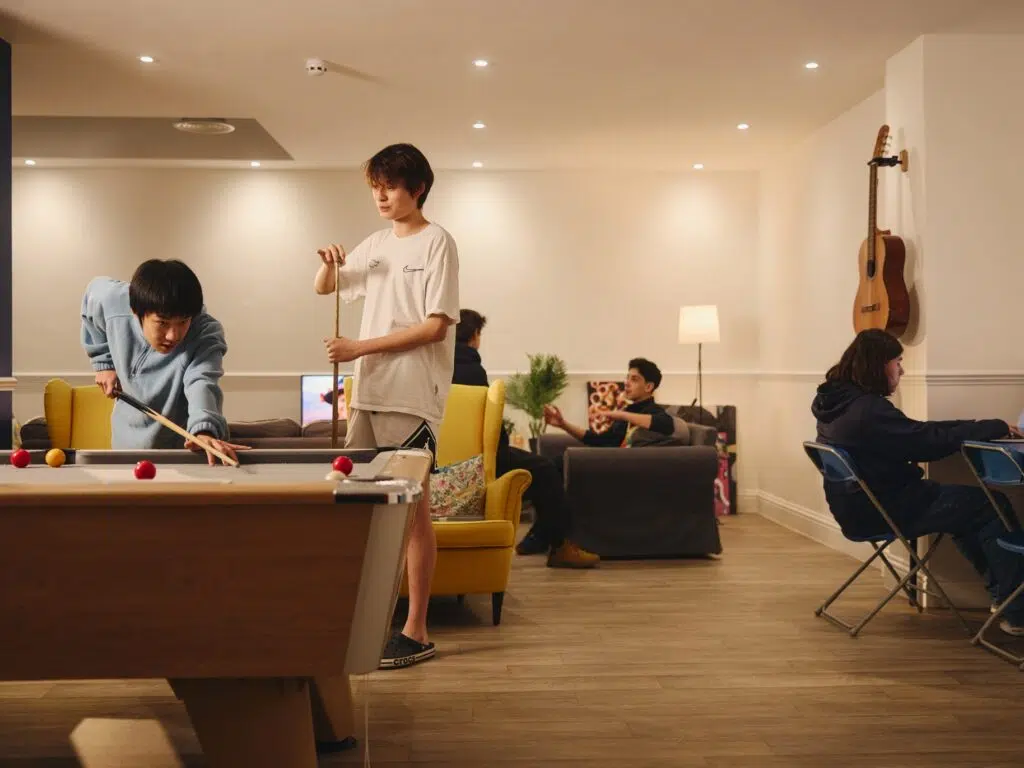
  • Common rooms & shared spaces – Each house has communal spaces including a common room, kitchen and garden, where students spend time together outside of lessons. These shared spaces are at the heart of house life. Many have open-plan kitchens, a social hub where students cook and bake together. Communal cooking is one of the small but meaningful ways students from different cultures share something of home with each other.
  • Wi-Fi and connectivity – All boarding houses have reliable Wi-Fi access. Students can stay connected with family and friends at home, though screen time and device use in bedrooms is managed during late evening study and lights-out periods.
  • Laundry – Laundry is carried out once per week (as advertised on the noticeboard). Baskets will be provided, and should be left outside the door before leaving for school on laundry day. For this purpose, we suggest that students have their names labelled on their clothes. Year 13 students are expected to do their own laundry. All students are encouraged to use the laundry facilities themselves and may do so during evenings or weekends in consultation with the house master/mistress / on a rota basis. We recommend that all items of clothing should be capable of being machine laundered/ironed, but we can provide details of local Dry-Cleaning services if required.
  • Bedding – Bedding  is provided and will be laundered in all houses weekly. You must strip your beds and leave the linen at the foot of your bed, and your bed will be remade for you. If you wish to bring your own bedding, you may do so, and this will also be laundered for you. Please ensure it is labelled with your name.

4. Dining at Earlscliffe

Meals at Earlscliffe are a communal affair. Students eat together in the school’s dining room, and mealtimes are designed to be a natural pause in the day — a chance to sit with friends and share food in a relaxed environment.

Hot meals are served throughout the day, with breakfast, a full lunch during the midday break, and supper in the early evening. Snacks are also provided at the morning and afternoon break.

The menu is varied and reflects the international makeup of the Earlscliffe community. Dietary requirements — including vegetarian, vegan, halal and specific allergen needs — are taken seriously and accommodated. Students with particular dietary needs should declare these clearly on their application so the catering team can prepare in advance.

In addition to the main dining room, many students enjoy cooking and baking in their boarding house kitchens, particularly on evenings and weekends. This communal cooking, often sharing recipes and dishes from home countries, is one of the most consistently loved parts of house life at Earlscliffe.

Meal times

  • Breakfast: 07:30
  • Lunch: 12:00
  • Supper: 18:00

A light breakfast may also be available in your boarding house and a light lunch can be pre-ordered in School House.

House Kitchen / Takeaways.

Students may keep food in the fridge/freezer and in designated cupboards in the house kitchen areas; all food must be labelled. Students are welcome to use the facilities in the kitchen during free time.

House staff, at their discretion, may allow students to order take-away food once over the weekend. Permission in advance must be obtained.

5. Appearance expectations - Dress code

Earlscliffe operates a smart dress code rather than a formal uniform. The philosophy behind this is simple: the school is preparing students for university and professional life, and looking presentable is part of that preparation. The dress code applies during lessons, meals in the dining room and formal school events.

Outside of formal school time — in boarding houses during the evening, at weekends and during leisure time — students may dress as they wish, provided clothing remains appropriate and respectful.

Practical tip: A few smart outfits go a long way. You do not need an extensive wardrobe — two or three well-chosen outfits for lessons, combined with comfortable casual wear for evenings and weekends, will cover most situations. The school will provide clearer guidance in the welcome pack. 

6. In the classroom - Academic life

Earlscliffe’s academic model is deliberately intensive. Everything about the academic structure, small classes, high contact hours, regular testing, and individual attention, is designed to drive students towards the best possible university.

  • Average class size: ~7
    No student is anonymous. Classes average around 7 students, which means teachers know every learner’s strengths, gaps and learning style and can stretch or support accordingly.
  • Up to 9 lessons per subject per week
    The teaching intensity at Earlscliffe is significantly higher than at most schools. Up to 9 lessons per subject each week means students cover the curriculum faster and with more depth.
  • Weekly TRaC™ testing
    Earlscliffe’s TRaC™ (Test, Rank and Coach) system means students are tested regularly on what they have learned. This is not about pressure — it is about ensuring knowledge sticks and gaps are caught early.
  • EPQ and enrichment
    All A-level students complete the Extended Project Qualification — an independent research project highly valued by universities. The SCS (Sports, Culture and Service) programme also ensures a rich life outside the classroom.
  • EAP in every lesson
    English for Academic Purposes is embedded across all subjects, not treated as a bolt-on. Teachers are experienced with international learners and plan lessons with each student’s language profile in mind.
  • Evening study
    The school day is followed by free time and dinner. From 7pm, a supervised evening study period gives students structured time to complete homework and revise before lights-out.

7. Safeguarding - Safety and security

The safety of every student is Earlscliffe’s primary responsibility. The school operates a comprehensive safeguarding framework aligned with UK statutory guidance, and all staff are trained in child protection and safeguarding procedures.

  • 24/7 on-site supervision
    House managers and duty staff are present throughout the evening and overnight. The campus is never unsupervised during term time.
  • Secure campus
    Access to school buildings and boarding houses is controlled via a facial recognition system. Visitors must sign in and are vetted. Students’ whereabouts are monitored throughout the day via a registration system.
  • Safeguarding policies
    Earlscliffe’s safeguarding and child protection policies comply with UK statutory guidance under Keeping Children Safe in Education. Policies are available on the school website.
  • Leave permissions
    Students must obtain permission before leaving the campus during the day or for any overnight stay. All leave is logged and parental permission is required for any absence from school.
  • Online safety
    The school’s network is filtered to block inappropriate content. Students receive guidance on online safety and responsible digital citizenship as part of the PSHE programme.
  • Anti-bullying
    Earlscliffe has a zero-tolerance approach to bullying in all forms — physical, verbal and online. The culture of the school actively promotes respect and mutual support across nationalities and backgrounds.

8. Expectations & standards - Student behaviour

Earlscliffe expects a high standard of conduct from all students, not to be restrictive, but because the school community functions at its best when everyone respects one another and takes responsibility for their own behaviour. The expectations are clear, consistently applied, and explained to every student during induction.

What the school expects

  • Punctuality — attending all lessons and registrations on time
  • Engagement — participating actively in class and in house life
  • Respect — for staff, fellow students and the school environment
  • Honesty — academic integrity in all work submitted
  • Responsibility — taking ownership of behaviour, belongings and personal space
  • Positive representation of the school on and off campus

Academic integrity: The use of AI tools or any form of dishonesty in assessed work is taken extremely seriously and treated as an academic integrity violation. Students are given clear guidance on what is and is not acceptable.

The school’s primary goal is always to support students in making better choices, not to punish. House managers play a key role in addressing low-level behaviour concerns informally and constructively before they escalate.

9. Outside of term - Holidays and time away from school

The Earlscliffe academic year is divided into three terms: Michaelmas (autumn), Hilary (spring) and Trinity (summer). Each term is punctuated by half-term breaks and ends with a main holiday period.

  • Term dates
    Earlscliffe’s term dates are published in advance on the school website. Planning travel around these dates early, especially for the Christmas and summer breaks, is strongly recommended to avoid high-cost flights.
  • Going home
    Many students travel home to their families during the main holiday periods. Students on Child Student visas should check their visa conditions before making travel plans.
  • Staying in the UK
    Students who remain in the UK during holidays must have accommodation arranged by their guardian, either with a vetted host family, in a residential holiday programme or with an approved relative or family friend.
  • Parent visits
    Parents are welcome to visit during term time, though visits should be arranged in advance with the admissions or pastoral team so they do not coincide with important academic commitments.
  • Visa and travel reminders
    Students on Child Student visas should be aware of the conditions attached to their leave to remain. Any travel outside the UK, even for short holidays, should be planned carefully to ensure re-entry goes smoothly.

Boarding life FAQs

How does Earlscliffe communicate with parents?

Parents are kept informed through several channels. House managers are the primary day-to-day contact for welfare matters and can be reached by email or phone. Academic updates, progress reports and formal communications come from teachers and the academic team. Parents are invited to attend online parents’ evenings and can also speak with their child’s guardian if one is appointed.

Earlscliffe actively encourages parents to reach out if they have concerns rather than waiting for formal reports. The school understands that being thousands of miles away requires an extra level of communication and transparency.

What mental health support is available?

Earlscliffe takes student mental health seriously. The school offers access to professional counselling for any student who needs it, either as a one-off session or on a more regular basis.

House managers are trained to recognise signs of mental health difficulties, including anxiety, low mood, stress and social isolation and to respond appropriately. The school’s culture around mental health is deliberately open: seeking support is normalised and encouraged, not stigmatised. The weekly PSHE programme also covers mental health awareness and resilience-building techniques as part of every student’s education.

What happens if my child is homesick?

Homesickness is completely normal and almost universal among students starting at a new boarding school, especially one so far from home. At Earlscliffe, house managers are experienced in recognising the signs and proactively supporting students who are struggling. They do not wait for a student to ask for help.

Support strategies include regular check-ins, encouraging involvement in house activities and communal meals, connecting students with peers from similar backgrounds, and, where needed, facilitating more frequent contact with parents. If homesickness persists or significantly affects wellbeing or academic performance, the pastoral team will escalate to professional counselling support.

Can parents stay for arrivals day?

Yes, parents are welcome and encouraged to accompany their child on arrival day and to meet the key staff who will be looking after them. Earlscliffe sees arrivals day as an important opportunity for families to feel confident that their child is in good hands.

Parents are given a tour of the facilities, time to meet house managers and teachers, and the chance to ask any final questions before departing. The admissions team will provide specific timings and logistical details, including parking, recommended arrival windows and where to go first, in the welcome pack.

EXPLORE EARLSCLIFFEDiscover More

BOOK A VISITWe'd love to welcome you to Earlscliffe in person

There's no better way to get a feel for Earlscliffe than to visit us in person. Walk our grounds, meet our staff and students, and explore the town we call home. Plan your visit to find out more.
Explore